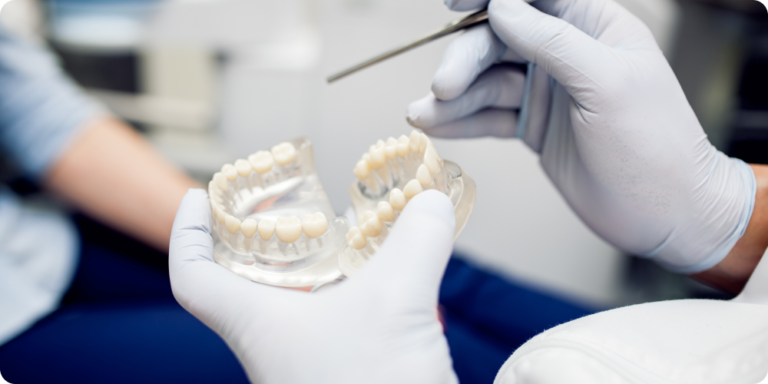
A well-fitting denture depends on balancing the bite forces of the denture teeth against properly contoured base flanges that work with the surrounding muscles rather than against them. The denturist accounts for the jaw joint, facial symmetry, ridge shape, and tongue size to create a denture that stays stable during normal function - including speaking and eating - without excessive pressure on any single area of the gum tissue.
A Denturists role to make a successful set of dentures for specific individuals is to understand the function of the head, neck, Temporal mandibular joint (TMJ) and the insertion and influence if the facial and oral muscles.
Dentures replace natural teeth, but do not replace the root function of natural teeth. Therefore dentures sit against the oral tissues of the Alveolar ridge left after the extractions of the teeth.
Stability and the ability to control the dentures is through the balance of the occlusion of the denture teeth and the contouring of the denture base flanges that engage the muscles of the mouth.
When you open your mouth to a large opening with natural teeth, it feels like your just opening your mouth. When this is done with dentures the lower denture rises off the ridge with the support of the muscles.
Some simple steps to balancing the dentures is with the plane of your eyes, facial symmetry.
Contouring the dentures is to utilize the ridge structures and tongue size to fabricate the dentures to the optimum size without interference of the tongue mobility which can push the dentures free of their foundation.
Denturists use measurements to determine the functional freeway space between our teeth for proper phonetics of speech while providing the soft esthetic smile that best suits that specific individual.
Steve Sailer, DD
NAIT Denturist Program graduate, registered with the College of Alberta Denturists since 1993, 32+ years of clinical practice.
Why do lower dentures feel less stable than upper dentures?
The upper denture is held partly by suction against a broad palatal surface, while the lower denture rests on a smaller horseshoe-shaped ridge and must coexist with the tongue and cheek muscles. As the post describes, the lower denture actually rises with the support of the muscles when the mouth opens wide - achieving this balance is the central challenge of lower denture fabrication.
How does a denturist determine the correct vertical dimension (bite height)?
Vertical dimension refers to the distance between the upper and lower jaws when the teeth are together. The denturist takes precise measurements and uses facial proportions - including alignment with the pupils at eye level - to establish a bite height that supports clear speech, comfortable chewing, and a natural facial appearance.
Can dentures affect speech?
New dentures often cause a brief adjustment period in speech, especially with sibilant sounds. Once the vertical dimension and tongue space are correctly set, most patients adapt within a few weeks. If speech remains unclear, the denturist can adjust the tooth position or base contour.
What role does the alveolar ridge play in denture stability?
The alveolar ridge is the bone and tissue remaining after tooth extraction, and it is the primary foundation that dentures rest on. A taller, broader ridge provides more surface area for stability. Over time the ridge naturally resorbs, which is why periodic relines and eventual replacement are necessary.
The process to fabricating dentures requires 4 appointments, including the complimentary initial consultation. The 1 st appointment is for taking impressions of your mouth;...